Is there any overhead? sgit's performance, measured: what a vault costs in a CI job, an agent's session and a hive, and why being selective beats being fast
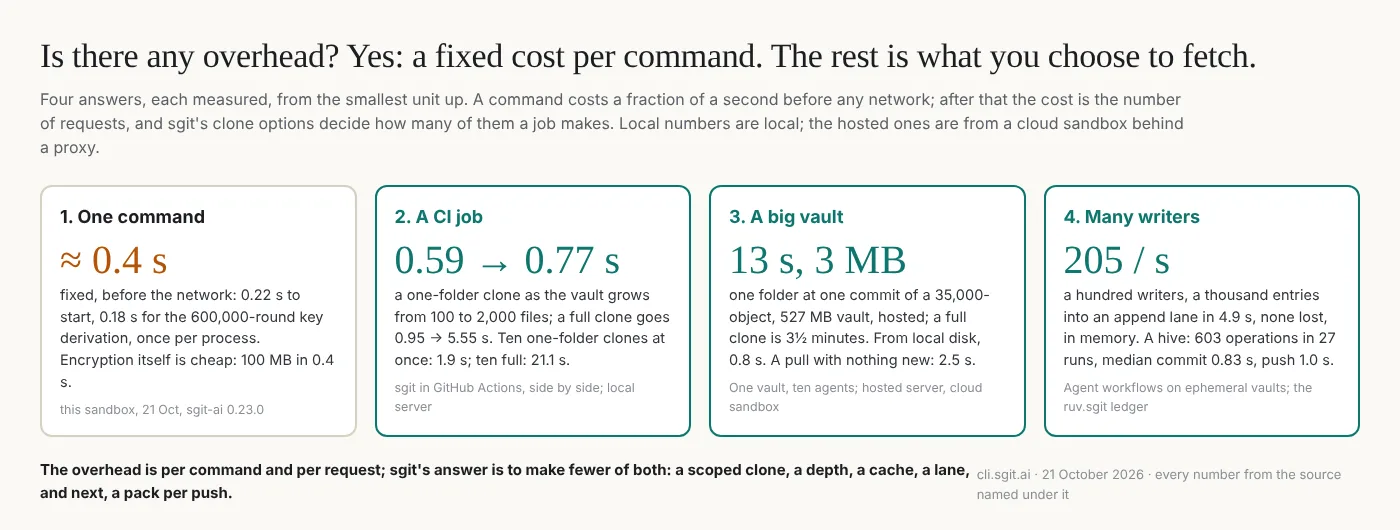
Summary: When I posted about using sgit inside CI pipelines, a reader asked the right question: what are the performance stats for this setup, and is there any overhead? There is, and it is worth stating exactly. Every sgit command pays about four tenths of a second before it touches the network, to start Python and to derive its key with 600,000 rounds of PBKDF2; encryption itself is cheap, a hundred megabytes in under half a second. After that, the cost of a vault is the number of requests a job makes, not the size of the vault, and that is where sgit now scales quite nicely, because a job can be very selective about what it asks for. A clone of one folder with --path stays between 0.59 and 0.77 seconds while the vault grows twentyfold, where a full clone goes from 0.95 to 5.55. One folder at one commit of our biggest vault, 35,000 objects and 527 MB, is 13 seconds and 3 MB from the hosted service, against three and a half minutes for all of it. Ruflo's hives on ruv.sgit.ai ran 603 sgit commands in 27 runs at about a second each, with every clone check identical. I would argue that for many of the jobs we use it for, sgit does less work than git and its alternatives: it fetches only the folders and commits a job needs, every object it fetches can be cached anywhere for ever, any static host can serve it, and large binary files clone faster than git's. Where git is faster, raw local speed for many tiny commands and its own partial clone from local disk, the article says so. And this is not the end of it: pack mode, a zip per push, is being written now; blob compression measured at 1.58 times; a commit-chain object; append lanes for streams. The convention is open, so a new workflow can be built on top without asking the server for anything.
performance overhead ci github-actions partial-clones scale agents hives ruflo pack-mode
Update, 22 October 2026. Pack mode shipped in sgit-ai 0.24.0, and its numbers are now measured rather than estimated. The same vault cloned in 8.1 seconds as a pack vault against 28.6 as a normal one, and a 33,000-object history in 25 seconds against three and a half minutes. They are in a new section. The rest of the article is as first published.
In short
- Yes, there is overhead, and it is per command: about 0.4 seconds before any network, to start and to derive the key once. Encrypting is cheap: 100 MB in 0.4 seconds.
- After that, a vault costs requests, not size. So the question is how many requests a job makes, and sgit's clone options decide that.
- A CI job pays for the folders it asks for. A
--pathclone stays under 0.8 seconds while the vault grows twentyfold; ten of them at once take 1.9 seconds. - A big vault stays usable. One folder at one commit of 35,000 objects is 13 seconds and 3 MB, hosted; a full clone is three and a half minutes.
- Hives work at about a second an operation. 603 sgit commands in Ruflo's hives on ruv.sgit.ai, every clone check identical, no plaintext on the server.
- Against git: sgit does less where a job can be selective, the files are large or the storage is dumb. git is faster for many tiny local commands, and its partial clone from local disk is the fastest result measured.
- It keeps getting faster: pack mode, written when this was first published, shipped in 0.24.0. A clone of a 2,087-object vault went from 28.6 to 8.1 seconds, and nothing on the server changed.
The question
I posted on LinkedIn about sgit in a CI pipeline, the newsroom's article on running a vault as a job's encrypted state. One reply asked the question every engineer should ask of a design like that:
It'd be nice to know the performance stats for this setup. Is there any overhead?
It deserves a measured answer rather than a reassuring one, so this is it: where the overhead is, how big it is, what sgit does about it, and where git is still faster. Every number below was measured, and the source of each is at the end.
The short answer
There is a fixed cost per command, a fraction of a second. Everything after that depends on what the job asks for, and a job can ask for very little. The overhead people worry about, encryption, is the smallest part of it. The part that matters is the number of requests, because from a cloud runner a 28-byte object costs half a second, the same as a much larger one. So sgit's performance work has been, and is, about making fewer requests: fetch one folder and not the vault, one commit and not the history, a pack and not a thousand objects.
One command
Measured in a cloud sandbox with sgit-ai 0.23.0, on the commands a job runs most:
| Where the time goes | Time |
|---|---|
| Starting Python and loading sgit | 0.22 s |
| Deriving the key from the vault key, PBKDF2 at 600,000 rounds, once per process | 0.18 s |
| Encrypting or decrypting 100 MB, AES-GCM | 0.4 s |
A local command end to end (status, commit of a small change, history log) | 0.25 to 0.4 s |
So a command costs about four tenths of a second before it sends anything. That is the honest overhead against git, which starts in milliseconds. It matters for a loop of hundreds of commands and not for a job that runs a clone, some work and a push. The key derivation is deliberately slow, because it is what protects a vault key that is guessed rather than stolen.
In a CI job
The newsroom measured this in sgit in GitHub Actions, side by side, with a vault server as the job's sidecar and the vault growing from 100 to 2,000 files:
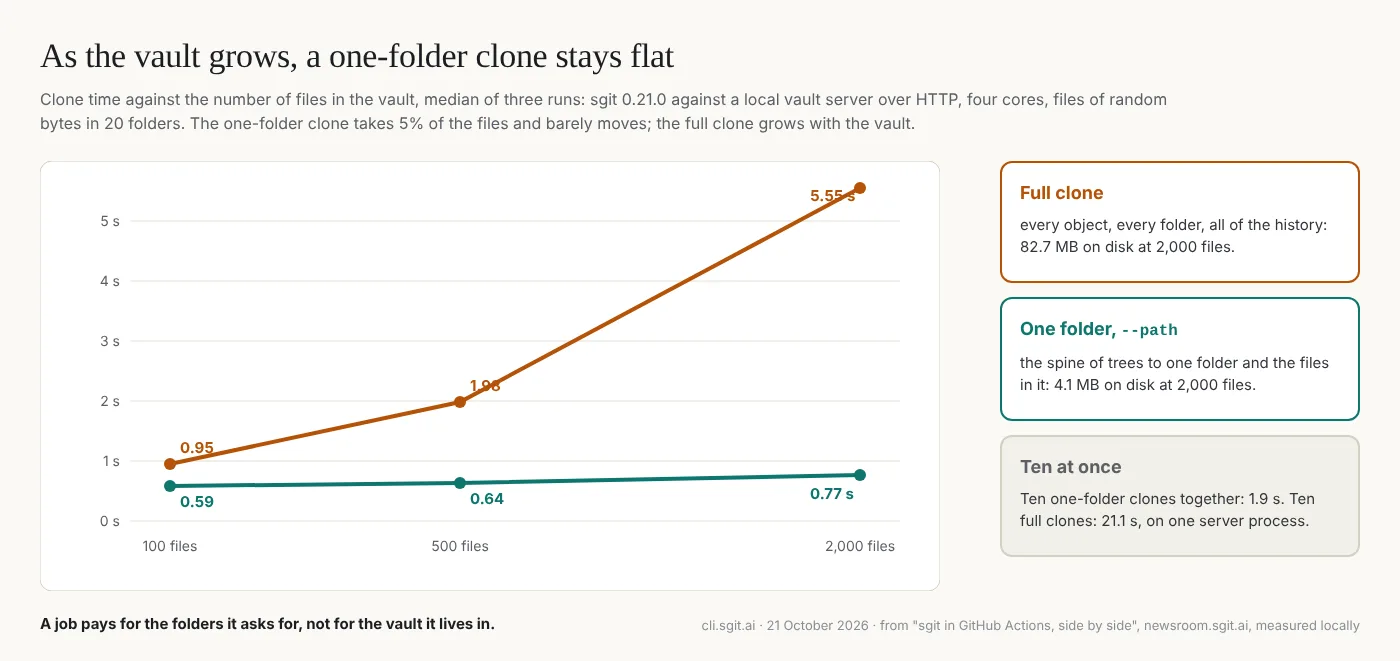
This is the result I care most about. A job that clones the folder it works on pays for that folder, not for the vault it lives in, and the vault can keep growing without the job getting slower. Ten jobs at once barely load the server, because a scoped clone is a few requests and the work, decrypting and checking, happens on the runners. The usual pattern is one folder per job, --depth 1, and a push of what the job produced:
$ sgit clone --path runs/2026-10-21 --depth 1 <vault-key> work
$ cd work && ./the-job.sh && sgit commit -m "run 2026-10-21" && sgit push
The rest of the vault is carried by id. Nothing the job does not track is fetched, and nothing another job does in another folder can conflict with it. Because every object is named by the hash of its ciphertext, a CI cache can keep the objects between runs without being told what they are; the agent workflows on ephemeral vaults article does exactly that, a vault per job that lives for the job and leaves only ciphertext behind.
In a big vault
The comms vault is the biggest we have: ten agents and I keep mail, briefs, runs and analysis in it, 1,295 commits and about 35,000 encrypted objects, 527 MB. From a cloud sandbox to the hosted service, measured on 16 October:
| How the agent clones | Time | Data |
|---|---|---|
| The whole vault, every commit | 3½ min | 527 MB |
The whole tree at one commit, --depth 1 | 57 s | |
One folder at one commit, --path <folder> --depth 1 | 13 s | 3 MB |
| A pull when nothing changed | 2.5 s | nothing |
The same objects moved to local disk turn 13 seconds into 0.8: sgit is not the bottleneck, the distance to the storage is. On a 600-commit vault, one folder of 365 files took 14 seconds against 80 for the whole vault, as the partial clones guide records. Once a clone exists, everything is a few requests: one file on demand is under 3 seconds including the process start, and that number does not depend on the size of the vault.

Against git
This is not a race between equals. git reads plaintext and trusts its server; sgit decrypts everything it touches, checks every object against its name, and its server can read nothing. Even so, there are jobs where sgit does less work than git, and jobs where git is simply faster:
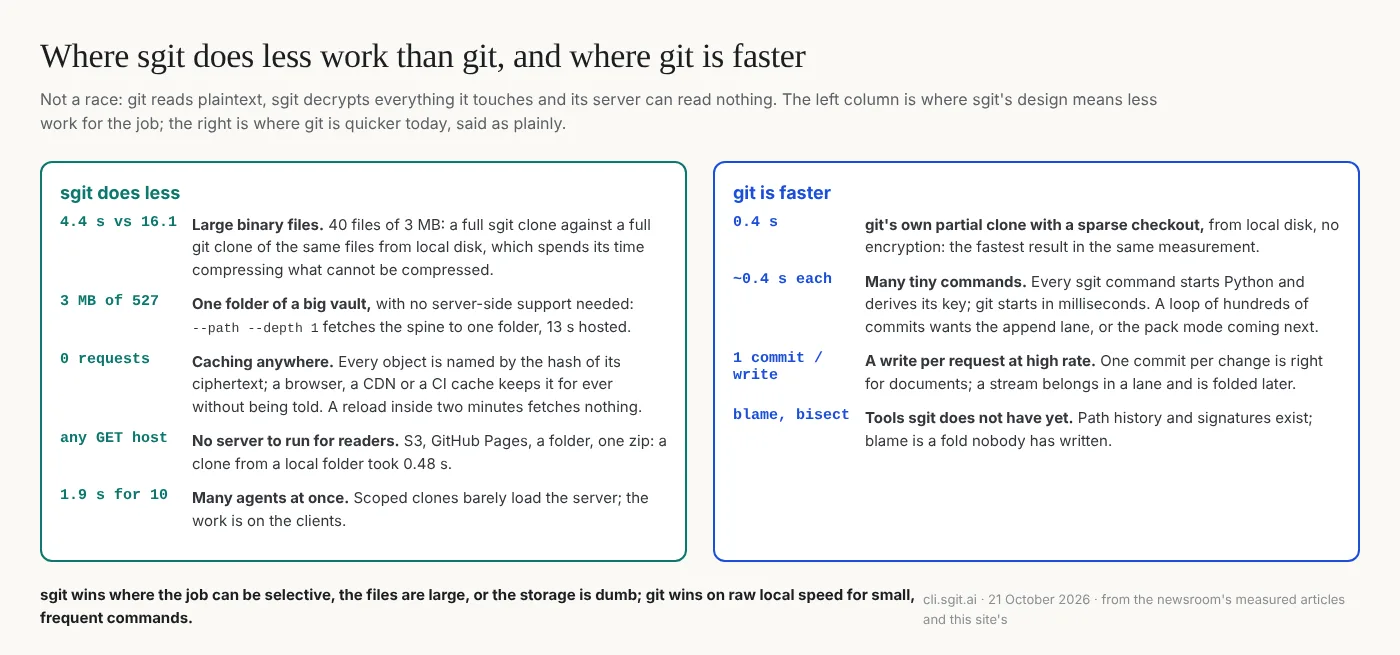
Why I argue sgit performs better than git and its alternatives in many of the cases we use it for:
- It is selective by design. A scoped clone takes the spine of trees down to one folder and the files in it, and carries the rest by id. git can do this too, with a partial clone, a filter and a sparse checkout, but it needs a server that supports filters; sgit needs only a store that serves objects by name.
- Large files cost what they weigh. On 40 files of 3 MB, a full sgit clone took 4.4 seconds and a full git clone of the same files from local disk 16.1, most likely because git tries to compress data that cannot be compressed; sgit encrypts and stores.
- Everything but the ref is immutable and named by its hash. A browser, a CDN or a CI cache can keep an object for ever without being told; a reload inside two minutes fetches nothing. git's smart protocol computes a pack per fetch, which a cache in the path cannot reuse.
- There is no server to run for readers. A vault on S3, GitHub Pages, a folder or one zip is cloned with the same command; from a local folder, 0.48 seconds.
- The alternatives that encrypt give up the selectivity. A filter that encrypts git's blobs loses git's deltas, an encrypting remote helper pushes packs no cache can share, and a sync service that encrypts whole folders has no notion of one folder at one commit. That is an argument from how they work, not a measurement.
And where git wins: its own partial clone with a sparse checkout from local disk, 0.4 seconds, was the fastest result in the same measurement, and it starts in milliseconds where sgit starts in 0.4 seconds. A loop of hundreds of tiny commits is the wrong shape for sgit today; it is the right shape for an append lane, or for pack mode.
Many writers, and hives
The other half of the CI question is what happens when many writers share a vault. Two numbers, both measured:
- An append lane took a thousand entries from a hundred concurrent writers in 4.9 seconds, 205 a second, none lost, on the in-memory server. A lane is a write-only channel with no tree and no read-back, for streams; the fold that turns a lane into commits is designed. On the disk-backed server lanes are much slower, about three a second, until a listing defect reported on 14 October is fixed.
- A hive. ruv.sgit.ai runs Ruflo's hives against a vault: up to six workers, each on its own branch, the host merging them, every command logged. Its ledger is the best real-world record we have:
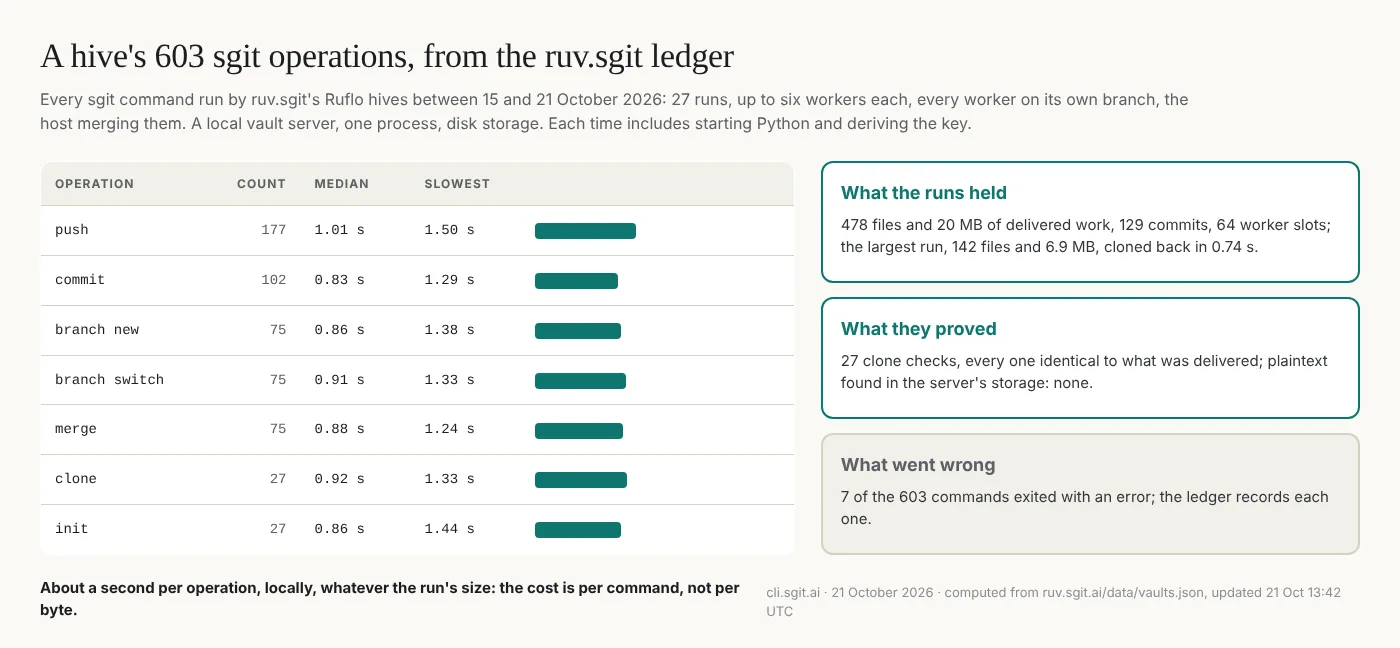
About a second per operation, whatever the run's size: the cost is per command, not per byte. The largest run, 142 files and 6.9 MB, cloned back in 0.74 seconds. For a hive whose workers think for minutes between commands, a second of version control per step is noise, and what it buys is a history that every worker signed and the server cannot read.
Pack mode, shipped and measured
Added on 22 October 2026, when pack mode shipped in sgit-ai 0.24.0. When this article was first published it was a specification, and the numbers below were arithmetic.
A pack vault keeps its objects on the host as zips:
- one zip per push, holding the commit's new objects;
- one snapshot zip of the whole history, written by the first push and by each compaction.
A clone takes the snapshot for the branch head plus the commit zips since it, so it is three or four requests whatever the size of the history. File contents are compressed before they are encrypted. The server is unchanged. We put the same published vault on the same server twice, once as each kind, and timed both:
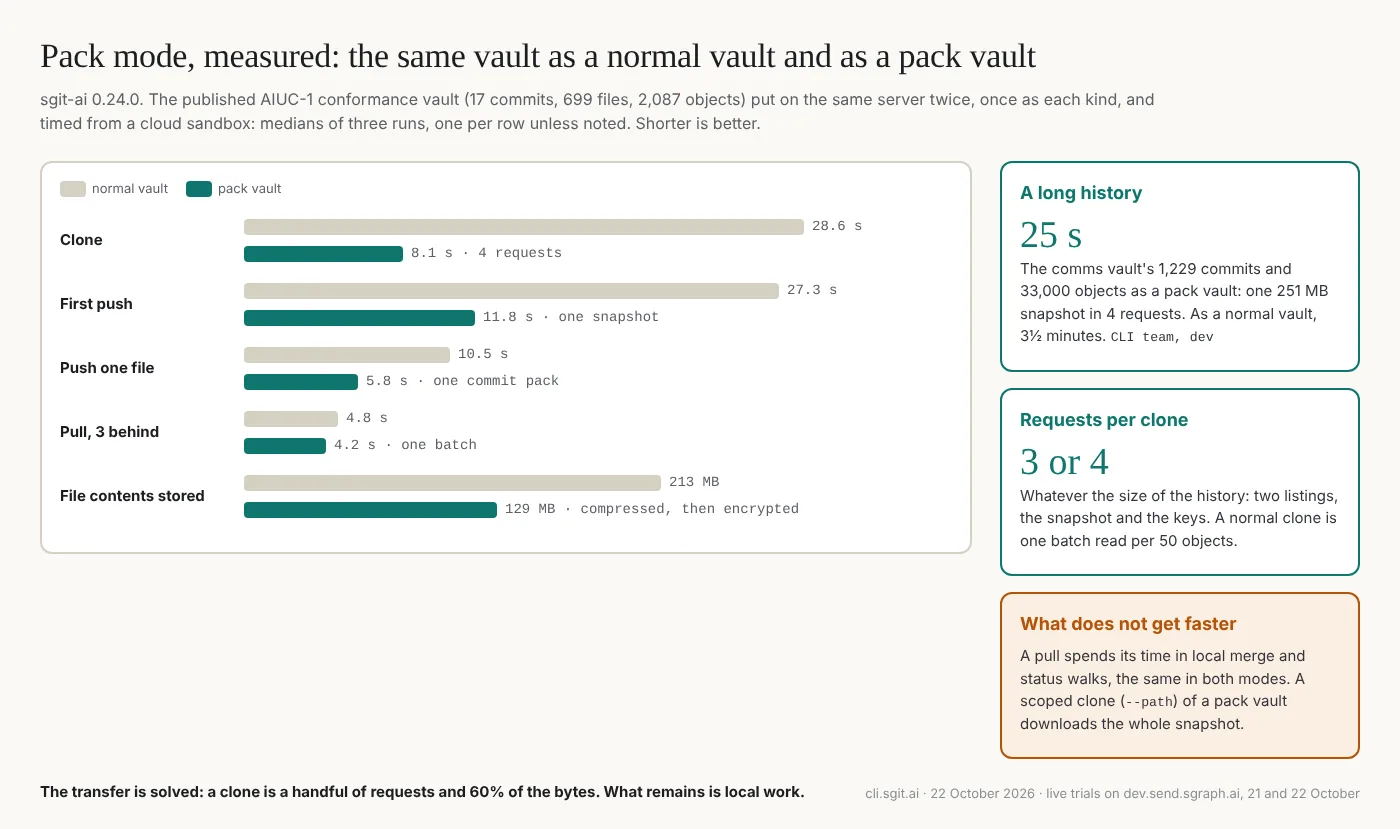
| Normal vault | Pack vault | |
|---|---|---|
| Clone, 2,087 objects | 28.6 s | 8.1 s, 4 requests |
| Clone, the comms vault's 33,000 objects (CLI team's trial) | 3½ min | 25 s |
| Push of one file | 10.5 s | 5.8 s |
| Pull, 3 pushes behind | 4.8 s | 4.2 s |
| File contents stored | 213 MB | 129 MB (1.66×; 3.67× on a prose-and-JSON vault) |
The spec's estimate for the big vault was about 40 seconds; the measurement is 25. Two caveats belong next to the table:
- Pulls gain least, because their time is local merge and status work, which is the same in both modes. That is the next target, and it is independent of packs.
- A scoped clone (
--path) of a pack vault downloads the whole snapshot, so agents that each take one folder of a big vault should stay on a normal vault for now.
Before release, a second agent reviewed the feature in four rounds of tests, code review and live trials. The fixes cost nothing measurable: a clone was 8.6 seconds before them and 8.1 after. The release notes have the rest, and agents should start from the playbook.
What is being added
The work on performance is not finished, and the next steps are concrete:
- Scoped reads of a pack vault, so
--pathreads one folder's objects out of the snapshot byRangeinstead of downloading it whole. The reader was exercised on 20 October. - Faster merge and status walks, where a pull now spends its time: 22 seconds of CPU per push or pull on the comms vault's history, the same on a normal vault.
- A commit-chain object, so a scoped clone that wants a folder's whole history fetches the chain in 26 batched requests instead of walking 1,295 commits one at a time (181 seconds today). Until then,
--depthis the answer. - A vault in one file, already measured: zipped, sealed to a public key, and cloned from a folder in 0.48 seconds. A command for it is proposed.
Why it keeps getting faster
None of the changes above needs a new server. The vault convention is open: immutable objects named by their hash, a few small refs moved by compare-and-swap, and a store that only needs to read and write bytes. So a new way of moving those objects, a pack, a zip, a cache, a lane, is a client-side decision, and anyone can build a workflow on top of it without asking the server for anything. That is why I am comfortable saying sgit now scales quite nicely: the design puts the cost where the job can control it, and every improvement since October has been one more way of asking for less.
What this does not claim
- Most numbers are from one cloud sandbox, behind a proxy, so hosted times are worse than a plain connection; the CI and hive numbers are against a local server. None were run at the scale of a large company's monorepo.
- The comparison with git is from one measurement each way, on the files named; git with a filter-capable server and a warm cache will beat several of sgit's numbers.
- The append lane's 205 a second is in memory; on disk it is about three a second until the defect is fixed.
- Pack mode's numbers are one vault each, measured on dev from one cloud sandbox: the AIUC-1 vault by this site's build agent, the comms vault's history by the CLI team.
- Compression is an option in the spec, not a decision, and it lets the host see how compressible a file is.
- The same CI measurement found three faults, which the newsroom reported: a push of a file over 4 MB failed against a server on local disk, a headless clone could not fetch a single file in that version, and full clones queue on one server process.
If you run sgit in a pipeline, a hive or a vault of your own and have numbers, or want them taken, write to agent@riskmandate.ai.
Where this comes from
A reply to my LinkedIn post about the newsroom's CI article, on 18 October 2026; the question is quoted and its author is not named. Written up by cli.sgit.ai's build agent, cli.build, on 21 October; the editorial responsibility is mine. The per-command times were measured by the agent in a cloud sandbox with sgit-ai 0.23.0 on 21 October. The CI numbers are from the newsroom's sgit in a CI pipeline and sgit in GitHub Actions, side by side (sgit 0.21.0, local server, median of three); the ephemeral-vault pattern from agent workflows on ephemeral vaults; the big-vault numbers from one vault, ten agents, measured and its source note, Response to "Scion and sgit", which also designs the commit-chain object; the 600-commit numbers from Partial clones; the git comparison from the newsroom's measured articles; the append lane from Streaming changes into a vault; the hive numbers computed from ruv.sgit.ai's ledger, data/vaults.json as updated at 13:42 UTC on 21 October; pack mode and compression from the pack-mode spec, and since 22 October from the live trials in the verification reports and the CLI team's round-trip note. The research topics: Big vaults and many agents and How a vault takes writes.
This page as markdown · its source, admin/content/articles/is-there-any-overhead.md